
It is often said that change is the only constant. As the world rides on the wave of digitalization, now the OEM industry has reached an inflection point. Implementation among early adopters has gradually given way to broader market penetration as end users and OEMs developed clear understanding of how the technology fits into their particular business models. The needs of those groups, in turn, put the responsibility for implementation on motion control suppliers, a dynamic that is transforming automation.
Traditionally, machine design followed a serial process of mechanical design followed by electrical design and controls. Once assembled, machines were commissioned, they are operated using manufacturing execution systems (MES), supervisory control, and data acquisition (SCADA) software. At each level, separate systems had to be interfaced and data transferred, requiring time, effort, custom code, and physical connections.
Today, OEMs place a greater emphasis on motion control. Programming and validation can be time-consuming and complex, particularly when it involves highly coordinated motion control. The goal of motion suppliers has been to develop applications that do the work for the OEMs and integrators, lessening their burden. This is particularly beneficial for machine builders who lack deep motion control expertise. The trend of simplifying software continues with making machine controllers and PLCs configurable instead of programmable. The approach enables OEMs and integrators to get their systems up and running far more rapidly than if they needed to develop custom code. When they need to modify a platform for a specific application or customer, they only need to reconfigure rather than re-engineer the application from scratch.
Simultaneously, modern components simplify this process with built-in connectivity, memory, and processing capabilities. Edge-computing devices tame the data monster, sending reduced data sets to the cloud where they can be mined with web-based analytics. The approach enables asset owners and service organizations to make rapid, informed decisions. Besides, application of simulation enables them to test out a wide variety of options while reducing the number of surprises. Simulation begins in the design phase using techniques like finite-element modeling to better understand performance. A detailed digital model that includes the masses that will be moved and rotated makes it possible to much more effectively size motors and gearboxes to optimize performance and minimize footprint and cost. Simulation enables OEMs to test out some of the functions of their machine design and do a more effective job of delivering application-specific features to the end user.
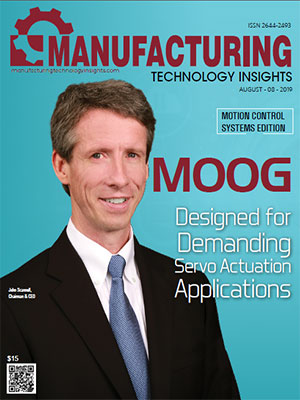
To help companies navigate through the best-breed motion control systems solution providers Manufacturing Technology Insights has compiled a list of leading motion control systems solution providers. A distinguished panel comprised of CIOs, VCs, and industry analysts, along with Manufacturing Technology Insights’ editorial team have evaluated and shortlisted organizations that have significantly stood out in the motion control arena for the year 2019. The companies featured in this issue through their business knowledge and industry prowess have established their eminence in the motion control solution sector.
We present to you Manufacturing Technology Insights’ “Top 10 Motion Control Systems Solution Providers – 2019.”